

Share
.svg)
.svg)
.svg)

Somewhere in your environment, there is a query with a forty-line WHERE clause.
It excludes study-abroad students, because they broke a retention report in 2017. It excludes three department codes that were retired in the reorganization, and maps two others to their current parents. It filters to a census snapshot rather than live registration, because a dean once received a number that changed overnight.
Every one of those lines is a policy decision, and every one of them was correct when it was written. Collectively they represent your institution's actual definition of an enrolled student, encoded in a place no governance process has ever reviewed and no other system can read.
Your institution is not short on data. It is short on a place where its data is validated, governed, and trusted.
Enterprise data practice has a name for that missing place: a system of reference. A system of reference is a governed data layer that connects information from systems of record—such as an SIS, CRM, LMS, HR, and financial system—and applies consistent institutional definitions, identities, relationships, lineage, and access rules. It gives people, applications, dashboards, and AI tools a trusted way to interpret institutional data.
System of record vs. system of reference: What's the difference?
Every campus is built on source systems, what enterprise architects call systems of record. The Student Information System (SIS) is authoritative about what a student registered for. The financial system is authoritative about what was spent. The Customer Relationship Management (CRM) system knows who inquired and when. Human Resources, the Learning Management System (LMS), and your advancement platform each hold the final word on their own transactions.
These systems are good at their jobs. They were built to process transactions accurately, and they were never built to answer questions that cross their own boundaries or to hold an opinion about what institutional concepts mean. The SIS defines enrollment in the way that serves registration. That definition is correct for its purpose, and it is one of several your institution legitimately needs.
The difference between a system of record and a system of reference is that the system of reference sits above to bring data from those source systems into one connected model. It adds what no system of record can carry alone: what "enrolled" means, which records refer to the same student, how a program is defined, where a number came from, and who is permitted to see it. Most institutions have plenty of source systems and no system of reference. What they have instead is a group of people functioning as one, and the forty-line WHERE clause is what that looks like in practice. It is institutional policy, stored in the only place available to the people writing it. That arrangement does not scale, it does not survive turnover, and nothing other than a person can call into it.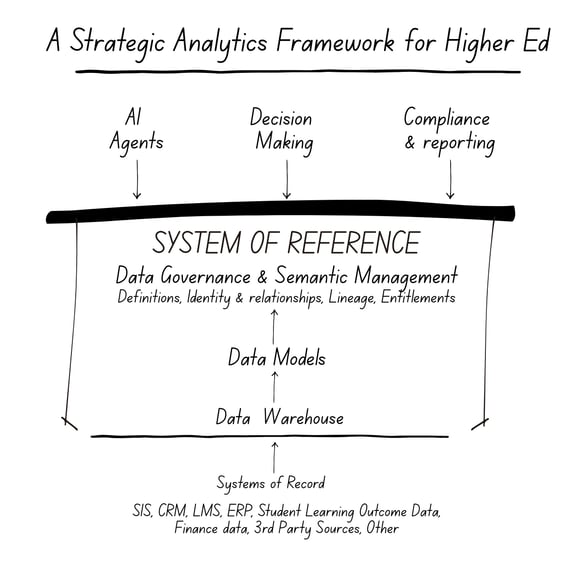
Why data governance in higher education is especially difficult
Higher education data governance is unusually difficult because institutional definitions vary by purpose, organizational structures change over time, and authority over data is distributed across academic and administrative functions.
One definition is never enough. A retailer can decide what a customer is and move on. Your institution cannot decide what a student is, because IPEDS requires one definition, your accreditor another, your state a third, and your budget model a fourth. All four are legitimate and all four have to coexist.
This is where most attempts at a single source of truth fail, because the goal gets stated as one number everyone agrees on. What a system of reference delivers instead is more than one definition of enrollment, each one named, each one owned, and each one returning the same answer every time it is asked.
The organizational unit will not hold still. Departments merge. Colleges reorganize. Programs get renamed, recoded, split, and folded into other programs. Every one of those events breaks the comparability of your own history, and the burden of maintaining a crosswalk falls on whoever remembers the change happened. Five years of turnover later, nobody does.
Authority is distributed by design. Shared governance means no Chief Information Officer can decree that enrollment shall henceforth mean one thing. A definition that faculty and deans have not agreed to is a definition that gets quietly ignored in favor of a local spreadsheet. The layer has to accommodate genuine disagreement and make its resolution visible, or it will be worked around.
The stakes are external and rising. Program-level accountability requirements, accreditor expectations around forward-looking evidence, and state performance funding all mean that being wrong about your own numbers is a compliance event rather than an internal embarrassment. Accreditors audit your evidence, which means they ask where each number came from and expect an answer that does not depend on who still works here..png?width=805&height=251&name=CTA%20Template%20Photo%20(2).png)
Aren't Our Current Data Tools Enough?
The short answer: no. Your institution has probably already invested in pieces you need, but here is where each piece stops.
Your SIS. Authoritative about registration and academic records, and genuinely excellent at it. It knows nothing about what instruction costs, what a graduate earns, or what a prospective student did before applying.
A general-purpose warehouse or lakehouse. Modern data platforms are very good at storage and computation, and they arrive with no opinion whatsoever about higher education. Yours came empty. Every table, every join, every institutional concept in it was modeled by your team or by whoever you hired. The platform solved the infrastructure problem and handed the meaning problem back to you.
Your business intelligence tool. Every dashboard encodes a definition in its filters and joins, invisibly to whoever reads the chart. Two hundred dashboards means two hundred uncoordinated definitions, with no way to tell which ones agree.
Your data catalog or governance tool. These document what exists. A catalog describes the data; it does not produce it. The moment a pipeline changes upstream, the catalog is describing a past state of the truth.
The AI agents your vendors are already shipping you. The newest item on the list and the one most likely to force the issue. Your SIS, CRM, advising platform, and learning platform vendors are all shipping assistants, and we are shipping them too. Each arrives with its own idea of what a student is.
Why AI Agents Need a Governed Institutional Data Layer
Every problem described so far predates AI by decades, and institutions have absorbed all of them the whole time by putting a person in the middle.
When a leader asked for a number, an analyst applied the right definition, excluded the right cohort, and attached the right caveat before the number left the building. That reconciliation was real work and it was almost entirely invisible. It also functioned as a control. A small number of people exercising judgment stood between the raw data and a decision.
An AI agent queries your source systems directly and skips that person. Whatever institutional knowledge lived in their head is absent from every answer, and the answer arrives formatted, fluent, and without a caveat.
Three things change at once. The volume of questions rises, because asking becomes free. The audience widens from a handful of governed reports to anyone on campus. And provenance disappears from view, because an AI answer displays no methodology, so the reader has no way to tell which definition of enrollment they just received.
A definitional gap that used to produce an argument in a meeting now produces a confidently wrong answer, at speed, to an audience you cannot see. Same underlying problem, considerably higher cost.
None of that is within your control to slow down, because the agents are arriving inside software you have already bought. Standardizing on one of them means fighting every vendor roadmap at once, and whatever your team picks this year will likely be replaced within three.
The layer underneath does not turn over that way. It is the same asset whether it is serving a dashboard, an analyst, a board report, or an agent.
Your institution does not need to standardize on one AI tool. It needs to standardize on one system of reference that every authorized tool calls into.
What does a system of reference require?
Connected institutional data.
This is the part that gets skipped because it is the expensive part. The systems above have different grains, different refresh cycles, different keys, and different ideas about what a term is. Bringing them into one model that holds together, and keeping it together as vendors push upgrades and your campus reorganizes colleges, is sustained engineering work. It is not a one-time integration project, and no amount of documentation substitutes for it.
The metadata has to travel with the data.
Aggregation without semantics gets you the same arguments at greater scale. What makes a connected data model into a system of reference is the governed layer sitting directly on top:
-
Governed definitions
Every contested institutional concept has agreed meanings, versioned, with a named owner, resolved down to the specific tables and filters that produce them. A definition recorded next to the data is a description. A definition enforced in the system that generates the number is the number. -
Identity and relationships
A student is one student across the CRM, the SIS, the LMS, and advancement. A program is one program across the cost model, the assessment record, and the degree audit. The links between them are modeled once and maintained centrally: student to section, section to instructor, instructor to cost center, program to requirement. Program-level cost allocation depends entirely on that chain being intact, and the source systems will never maintain it on your behalf. -
Data Lineage
Every number can be traced from the answer back through each transformation to the source it came from, and that trace is available to whoever has to defend it.
-
Role-based Access and Entitlements
Access follows a person's role and is enforced at the data layer, so the same rules apply whether the request arrives from a dashboard, a scheduled report, or an agent asking on someone's behalf.
What does a system of reference enable?
Architecture is only interesting for what it lets leaders do differently.
Program review reaches a conclusion instead of stalling in a debate about whose enrollment figure is right. Accreditation evidence accumulates continuously, so the decennial review stops being an eighteen-month scramble. Board materials tie out to the budget because both draw on the same model. A cabinet spends its time on the tradeoff. Nobody has to relitigate the methodology first.
And every AI agent that arrives on campus over the next several years has somewhere authoritative to call into on its first day, rather than requiring a fresh integration project and a fresh set of assumptions.
The real test is durability. Does the data layer survive a reorganization, a vendor upgrade, and the departure of the person who understands it best?
At HelioCampus, we have spent a decade building this data layer with institutions of every size, well before it became the interesting part of the conversation. Trusted AI requires trusted data, and the trusted data has to come first.
Somewhere in your environment, that forty-line WHERE clause is still running. Everything encoded in it is correct. The work ahead is moving what it knows into a place the whole institution can reach.
FAQs:
