FLORIDA GULF COAST UNIVERSITY CASE STUDY
Building an Assessment Culture Worth Celebrating
How Florida Gulf Coast University turned a fragmented, spreadsheet- and email-based assessment process into a campus-wide practice with HelioCampus.
Florida Gulf Coast University (FGCU) is one of 12 public universities in the State University System of Florida, serving nearly 17,000 undergraduate and graduate students across six colleges and two schools.
When Merri Incitti arrived as Director of Assessment and Accreditation, she inherited an assessment process held together by SharePoint folders, email chains, and whichever program coordinator still happened to have the files. A few years later, FGCU is running direct and juried assessment at a campus-wide scale, celebrating faculty progress with an annual party, and heading into its next reaffirmation cycle with a very different story to tell — one that starts, like a lot of good stories, with a mess.
Case Study Highlights
2x
YoY increase in assignments linked for direct assessment
0
formal training sessions needed for faculty evaluators
10x
YoY increase in artifacts for jury review
0
Recommendations in FGCU's latest SACSCOC decennial reaffirmation

A decennial report, and a system held together by email
Incitti arrived at FGCU a little over three years ago — right in time to start writing the university’s SACSCOC decennial report for an institution she had no prior history with. FGCU’s submission process wasn’t even routed through its learning management system (LMS); it ran on a combination of SharePoint and email, and documents regularly ended up in the wrong person’s folder or inbox. A stretch of pandemic disruption and hurricane seasons hadn’t helped matters, either. Faculty hadn’t revisited FGCU’s state-mandated learning outcomes — then still called “academic learning compacts” — since 2012.
When Incitti asked program coordinators why reporting felt like such a hassle, she heard the same answer again and again: no one reads it, so why bother? Meanwhile, juried assessment — long considered assessment’s gold standard — was happening on paper, in small rooms, with a handful of faculty scoring a handful of assignments by hand. FGCU’s general education program, serving a student body of 16,000, was drawing samples of roughly 25 artifacts a year. The last manual juried review of critical thinking, Gen Ed’s largest competency, pulled just 86 artifacts from four sections out of more than 1,500 general education sections offered that year. “Anyone who’s tried to run assessment through SharePoint and email knows things get lost rather quickly,” says Incitti.

Building the foundation, one relationship at a time
FGCU brought on HelioCampus Assessment Management around the same time Incitti was drafting the decennial report, and rolled it out deliberately — a small, centralized assessment office didn’t have the bandwidth to move fast. The first use was practical: rebuilding the reporting workflow FGCU needed to satisfy SACSCOC, while Incitti wrote the self-study itself inside the platform. Annual and biennial reporting is now far more manageable, backed by evidence that used to live in scattered folders.
The real foundation, though, was relationships. Incitti met one-on-one with the program coordinators who own assessment on FGCU’s campus, learning what would actually make their work easier rather than layering new requirements on top of old ones. That listening tour surfaced a consistent pain point: departments wanted to run juried assessment but couldn’t get it off the ground, and gathering artifacts was the hardest part. Between direct and juried assessment inside HelioCampus, most of FGCU’s artifacts now live in its LMS instead of a departing faculty member’s hard drive.
From 25 samples to thousands
Joe Ross, Director of Undergraduate Studies and a 14-year member of the political science faculty, took on FGCU’s general education juried assessment pilot. FGCU’s Gen Ed program is built around five competencies — including critical thinking, human expression & society, and quantitative reasoning — that cross-disciplinary boundaries by design, giving faculty a sense that they’re assessing real program outcomes rather than checking a state-mandated box.
Ross used HelioCampus to change the math on sampling. His pilot juried assessment of critical thinking drew from more than 6,000 available artifacts across 14 courses in 17 disciplines, taught by 32 different faculty. He recruited 11 faculty evaluators from 11 different departments to score them, two reviewers per artifact — support he was able to fund with modest stipends. By the pilot’s second year, more than half of FGCU’s Gen Ed sections had at least one assignment linked for direct assessment, double the year before, and Ross had roughly 7,000 artifacts on hand to sample from for that year’s juried assessment cycle.

Faculty evaluators needed almost no ramp-up. Ross skipped a formal training session and sent an email with a few screenshots instead. In a post-pilot survey, evaluators rated the tool’s difficulty at an average of 0.75 out of 10 — five of eight respondents said zero.
"The evaluators have such an easy time with HelioCampus — that’s the best part. I’ve spent more time explaining the rubric and our competencies than I have the platform itself."
Joe Ross
Director of Undergraduate Studies
Making the case for assessment over grading
One of Ross’s most persuasive moves was a simple side-by-side comparison. He showed faculty FGCU’s direct assessment results for critical thinking — which are effectively grades, clustered in the A and B range with little variation — next to the same students’ juried assessment scores, which showed far more differentiation. For faculty who weren’t previously part of assessment conversations, the contrast reliably produced what Ross calls a lightbulb moment: a student can earn full marks on an assignment for doing exactly what was asked, without yet showing the deeper skill development the university is actually trying to measure. That distinction — between what a grade certifies and what an outcome reveals — has become one of Ross’s most effective tools for building faculty buy-in, both for juried assessment specifically and for FGCU’s broader culture of assessment.
Gen Ed Palooza: making assessment something to celebrate
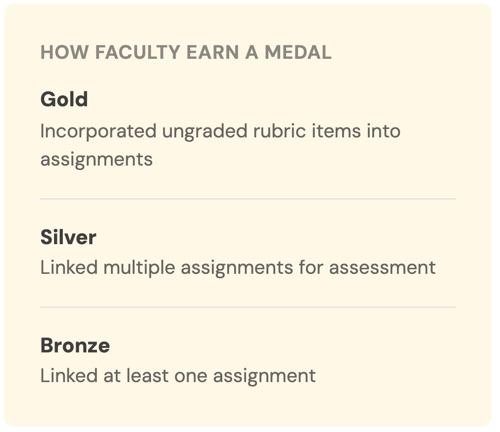
Rather than another meeting, FGCU turns its general education assessment cycle into a party. “Gen Ed Palooza” now happens once a year, complete with food, presentations, and a theme — the most recent was “Third Time’s the Charm,” lucky-charms T-shirts included — with deans, department chairs, and even the provost known to stop by the taco bar. Ross layered a lightweight, Olympics-style incentive on top of it: faculty who incorporated ungraded rubric items into their assignments earn gold, those who linked multiple assignments earn silver, and anyone who linked at least one earns bronze, tracked in a running medal count Ross emails out by name and department.
None of it would have worked, Incitti said, without a hard line the university drew early: assessment results are walled off from faculty’s annual performance reviews. FGCU’s provost said so explicitly, out loud, at the very first Palooza — a decision Incitti calls a turning point in getting faculty to engage honestly rather than defensively.

"It’s the least expensive carrot we’ve ever offered for assessment, and it’s working better than any stipend we’ve paid."
Merri Incitti
Director of Assessment and Accreditation
The pay-off
FGCU’s most recent SACSCOC decennial review came back with zero recommendations and full reaffirmation. Program coordinators who once had to be chased down for artifacts are now the ones asking for help, requesting the same juried assessment support Ross built for Gen Ed. In 2025, FGCU held its inaugural year of program-level assessment awards — Gold, Silver, and Bronze for Best Assessment Report, plus a Most Improved Program award to be added for 2026 — with the Faculty Senate backing a plan to attach real prize money the following year. And faculty are voluntarily coordinating across sections on shared assignments and instructional approaches, a level of cross-department collaboration that mostly wasn’t happening before Gen Ed had a common evidence base.
A single workflow for assessment
FGCU replaced an assessment process built around SharePoint, email, and scattered files with a centralized workflow in HelioCampus, making annual reporting and evidence collection far more manageable.

Integrous juried assessment, at scale
With HelioCampus, FGCU expanded its assessment reach dramatically from 25 artifacts sampled annually to more than 800 reviewed in its juried assessment pilot, with thousands available for sampling.

Assessment faculty look forward to
FGCU made assessment a shared, collaborative practice by giving faculty an easier way to participate, separating assessment from performance reviews, and introducing creative incentives like its annual “Gen Ed Palooza.”

What's next
FGCU is now working to connect its general education program to the majors it feeds into — building documentation, in partnership with the College of Arts and Sciences, that shows students how a Gen Ed course maps to the work they’ll do later in their program, with an eye toward linking it to FGCU’s digital badging system. The Academic Roadmaps are being launched by Spring 2027 as marketing material for non-declared majors. Gen Ed Palooza is moving up to September to align with the university’s assessment cycle, and Ross is leading faculty working groups through a deep dive into the results for human expression & society and quantitative reasoning, while preparing faculty teaching in scientific inquiry and writing & communication — the two competencies up for review next spring.
It’s a long way from 25 hand-gathered artifacts and a submission process held together by SharePoint and email. But ask Incitti what’s changed most, and she won’t point to the artifact count first — it’s that faculty who once dreaded an email from the assessment office now ask when the next Gen Ed Palooza is.